Most people shopping for a tow vehicle look at one number, the towing capacity, and it is usually generous. The number that ends the conversation is a different one, printed on a sticker inside the driver's door, and most buyers never look at it until the truck is already sitting low in the back.
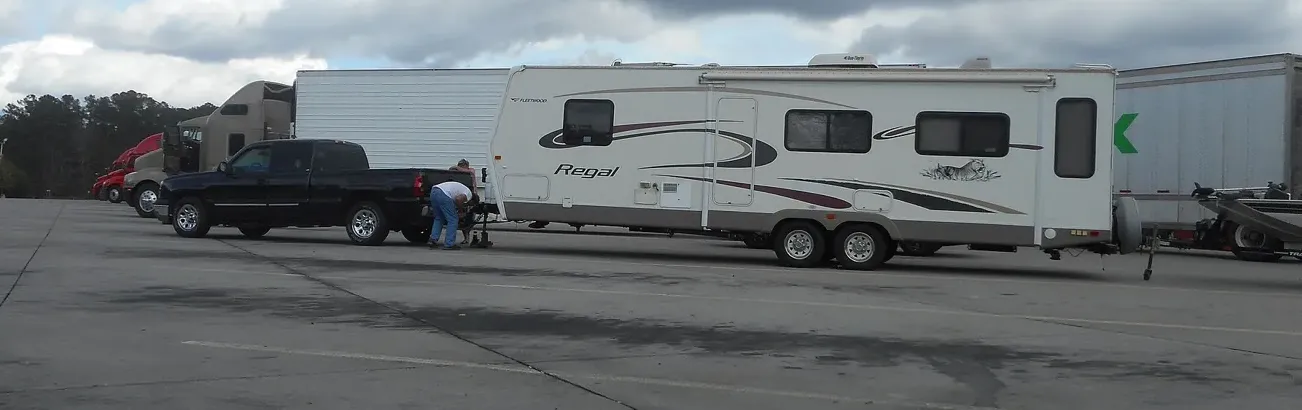
Two budgets, not one
Towing capacity, properly the trailer weight rating, is how heavy the trailer can be. It is about what happens behind the truck: the frame, the hitch, the cooling system, the brakes.
Payload is how much the truck itself can carry: people, cargo, accessories and anything else on board. The figure on the door label is the factory payload, for the truck as it was built. What you have left on a given day is your GVWR minus what the truck actually weighs with everything already in it. It is about the truck's own springs, axles and tires.
These look like separate problems, and that is the trap. They are linked by the one part of the trailer that is not behind the truck.
The tongue is cargo
A trailer does not just roll along behind you. A share of its weight presses down on the hitch, and as far as the truck is concerned, that is load it carries, just like cargo. The manufacturers say how big that share should be:
| Hitch | Share on the truck | Who says so |
|---|---|---|
| Ball hitch (conventional) | 9 to 11% | Toyota, 2024 Tacoma manual |
| Ball hitch (conventional) | 10% | Ford, 2026 Super Duty guide |
| Ball hitch (conventional) | 10 to 15% | Chevrolet, 2026 trailering guide |
| Fifth wheel or gooseneck | 15% | Ford, 2026 Super Duty guide |
Run those percentages against common trailer weights and the numbers get big quickly:
| Loaded trailer | Tongue at 10% | Pin at 15% |
|---|---|---|
| 5,000 lb | 500 lb | 750 lb |
| 7,500 lb | 750 lb | 1,125 lb |
| 10,000 lb | 1,000 lb | 1,500 lb |
| 15,000 lb | 1,500 lb | 2,250 lb |
| 20,000 lb | 2,000 lb | 3,000 lb |
Ford also tells you where that weight goes: "Make sure vehicle payload (reduce by option weight) will accommodate trailer tongue (trailer king pin for 5th-wheel towing) load weight and weight of passengers and cargo added to towing vehicle." Every pound of tongue is a pound of payload you no longer have.
Run the numbers once
Here is a deliberately ordinary example (made-up figures, but typical of the math). Your truck is rated to tow 11,000 lb, and its door sticker says it can carry 1,600 lb, with nothing added since it left the factory. You want to tow a 9,000 lb travel trailer, 2,000 lb under the towing rating.
At 10%, the tongue puts 900 lb on the hitch. That leaves 700 lb. Four adults at 175 lb each is 700 lb. You are at the limit, and you have not yet loaded the cooler, the camp chairs, the firewood or the weight-distributing hitch itself.
The trailer is fine. The truck is at its limit, and the first bag of ice puts it over. This is a common way to end up overloaded, and the towing number never warned you, because it was answering a different question.
Our advice
It is a first filter, not a full check: it says nothing about GCWR, axle and tire ratings or the hitch's own rating, and it is only as good as the tongue share you assume. With 700 lb left, 10% gives 7,000 lb of trailer; 15% gives only about 4,670 lb. Weigh the real tongue when you can. On many half-tons, this payload number will be the smaller one. Two more things we would keep in mind. The door sticker is for the truck as it left the factory, so a bed cover, a toolbox, running boards or a bigger set of tires all come off it. And payload varies a lot between versions of the same model: a basic regular cab and a fully loaded crew cab can differ by hundreds of pounds, and the expensive one is usually the one that carries less.
When the math doesn't work, a lighter trailer or a heavier truck is the answer. Airbags and helper springs make a sagging truck look level, but they do not change what the axle and tires are rated to carry.
Towing ratings by year and configuration: F-150, Silverado 1500, Tundra, Tacoma, Super Duty. For the limits on the door label, see GVWR and GCWR explained; for pin weight, fifth wheel vs gooseneck.
Sources
- 2024 Toyota Tacoma Owner's Manual, p. 206 (tongue weight)
- 2026 Ford Super Duty Pickup Towing Guide, p. 6 (tongue and pin weight, payload)
- Chevrolet 2026 Trailering Guide, p. 26 (tongue weight)
 GVWR, GCWR and towing capacity, explained
 How much can a half-ton truck tow?
 Fifth wheel vs gooseneck