The short answer for a 2026 truck: up to 13,500 lb for a Ford F-150, 13,300 lb for a Chevrolet Silverado 1500 and 12,000 lb for a Toyota Tundra (Ram 1500 figures are not covered here). Those are the manufacturers' own figures, and they are real. They are also the numbers most half-ton owners will never be able to use, and it is worth understanding why before you buy a trailer.
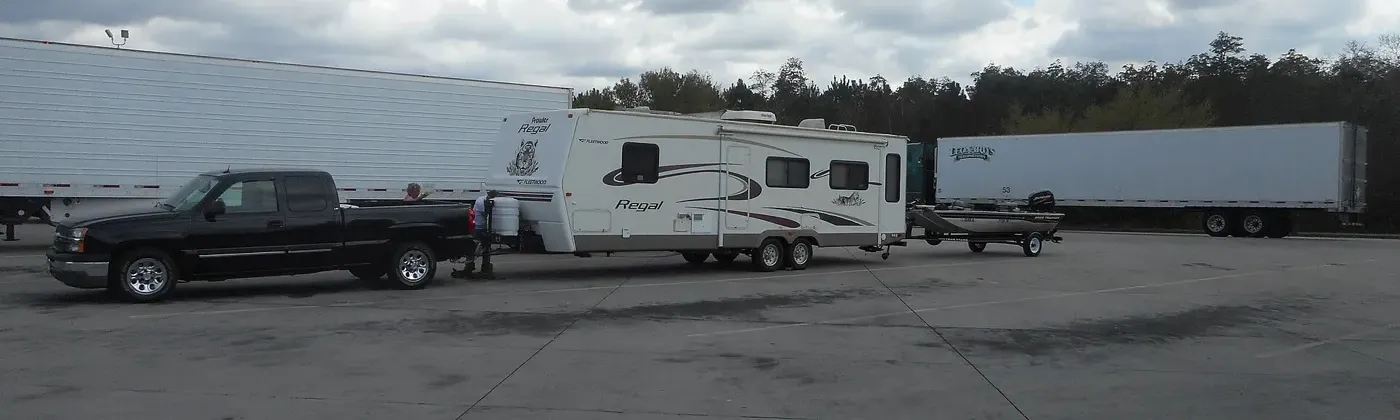
The headline number belongs to one truck
Each of those maximums is earned by one specific build:
| 2026 | The build behind the maximum | Max |
|---|---|---|
| F-150 | SuperCrew 4x4, 157.2 in wheelbase, 3.5L EcoBoost, 3.55 axle | 13,500 lb |
| Silverado 1500 | Double Cab 2WD, 3.0L Duramax diesel, Max Trailering Package, 20 in wheels | 13,300 lb |
| Tundra | Double Cab without the SR Package | 12,000 lb |
Step away from that build and the number falls quickly. Ford's 2026 F-150 table runs from 13,500 lb down to 7,400 lb, the bottom being 2.7L EcoBoost trucks. The 2026 Silverado 1500 goes from 13,300 lb down to 8,700 lb for the off-road ZR2 with the 3.0L diesel. The 2026 Tundra spans 12,000 to 8,300 lb. Same badge on the tailgate, ratings that differ by a factor of two.
Equipment matters as much as hardware. Ford's 2021 F-150 tables, the year the truck peaked at 14,000 lb, carry a footnote that says it plainly:
"Do not exceed a trailer weight of 7,000 lbs. with only the Class IV hitch (53B), without the Trailer Tow Package (53A)."
A truck that left the factory without one option code is a 7,000 lb truck, whatever the brochure said. If you are buying used, the window sticker or the build sheet matters more than the engine badge.
Payload runs out first
Even on the right build, the trailer rating assumes a nearly empty truck. Ford's 2026 F-150 guide states that its maximums are "for properly equipped vehicles with required equipment and a 150-lb. driver and passenger". Everything else you put in the truck, including part of the trailer itself, comes out of the payload.
That last part is the one people miss. Around 10% of a conventional trailer's weight rests on the hitch ball, which is Ford's figure; Toyota says 9 to 11%. On a 10,000 lb travel trailer that is about 1,000 lb sitting in the truck before anyone climbs in. Say your door sticker shows 1,500 lb of payload (an example; yours depends heavily on cab, trim and options). Add four people, a weight-distributing hitch and some gear:
That truck is over its payload with a trailer thousands of pounds under its towing rating. This is why towing forums are full of people who "can tow 13,000 lb" and are overloaded at 9,000. The rating was never wrong. It just answers a different question from the one they asked. Our article on payload vs towing capacity walks through the math.
So what will a half-ton really handle?
The math is short. Take the payload left after passengers, gear and the hitch itself, and divide by the share of the trailer that rests on the ball. At Ford's 10%:
| Payload left for the tongue | Heaviest trailer at 10% | At 15% |
|---|---|---|
| 500 lb | 5,000 lb | 3,333 lb |
| 700 lb | 7,000 lb | 4,667 lb |
| 900 lb | 9,000 lb | 6,000 lb |
| 1,100 lb | 11,000 lb | 7,333 lb |
Chevrolet's trailering guide puts conventional tongue weight at 10 to 15%, which is why we show both columns: a trailer that loads heavy at the front can halve your margin. Weigh the real tongue if you can. Run those numbers for a crew cab with a family aboard and the result tends to land well below the headline rating; that is why, in our view, heavy travel trailers and anything with a kingpin usually belong on a three-quarter-ton, for its payload and springs more than its engine. See fifth wheel vs gooseneck for what heavy-duty ratings look like.
That is not a reason to distrust the big numbers. An F-150 ordered for the 13,500 lb rating can use it, provided its own payload, axle ratings, GCWR and hitch ratings all hold with the real load. It just takes a buyer who ordered that truck on purpose and checks the numbers before hooking up.
The numbers keep moving
Don't assume this year's figure applies to your truck.
| Highest rating | 2019 | 2020 | 2021-2023 | 2025-2026 |
|---|---|---|---|---|
| F-150 | 13,200 | 13,200 | 14,000 | 13,500 |
| Silverado 1500 | 12,200 | 13,400 | 13,300 | 13,300 |
| Tundra | 10,200 | 10,200 | 10,200 / 12,000* | 12,000 |
Pounds, conventional hitch. *Tundra: 10,200 lb in 2021, 12,000 lb from the 2022 redesign. 2024 is not shown for the F-150.
One oddity worth knowing: Toyota prints the 2026 Tundra's combined rating as 17,770 lb next to 8,030 kg, which is closer to 17,700 lb; the two figures in the manual don't match. We show the figure as printed and flag it. If you plan to tow near that limit, ask Toyota or a dealer to confirm the rating for your truck rather than guessing which number is right.
The only number that counts is the one for your model year and your exact configuration. Our tables list every row the manufacturers publish: F-150 towing capacity, Silverado 1500 towing capacity and Tundra towing capacity. Before you hook up, check GVWR, GCWR and the other towing limits too.
Sources
- 2026 Ford F-150 Towing Guide, p. 3
- 2021 Ford RV & Trailer Towing Guide, p. 20
- Chevrolet 2026 Trailering Guide, p. 26 (ratings and tongue weight)
- 2026 Toyota Tundra Owner's Manual, p. 195
- 2026 Ford Super Duty Pickup Towing Guide, p. 6; 2024 Toyota Tacoma Owner's Manual, p. 206 (tongue weight)
- Earlier model years: Ford, Chevrolet and Toyota guides and manuals listed on each towing page
 Payload vs towing capacity
 GVWR, GCWR and towing capacity, explained
 Fifth wheel vs gooseneck