Ask at any campground and you will hear that the two hitches are basically the same thing. Both mount in the bed, both put the trailer's weight ahead of or over the rear axle, and both tow far more than a bumper-pull. All true. What the campground argument misses is that the truck maker publishes a separate number for each, and on a current Ford Super Duty those numbers can be thousands of pounds apart.
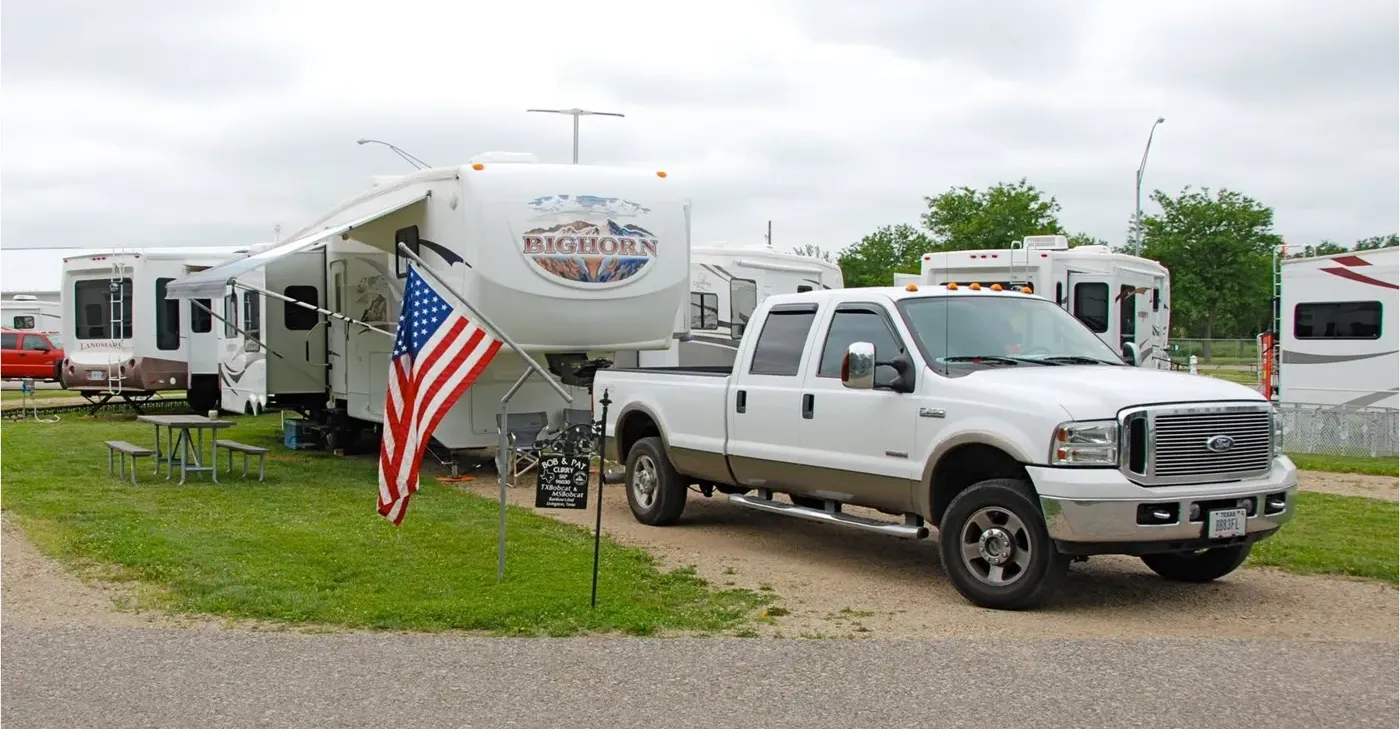
Same idea, different coupling
A fifth-wheel hitch is a heavy plate with locking jaws, bolted to rails or a factory puck system in the bed. The trailer has a vertical kingpin that slides into those jaws, the same principle as a semi coupling, scaled down. It is what most large RV trailers are built for, and it takes up a good part of the bed.
A gooseneck hitch is a ball set into the bed floor, usually 2-5/16 in, often able to flip over or drop out of the way when you are not towing. The trailer's long neck reaches over the tailgate and its coupler drops onto the ball. It is the usual coupling on livestock, flatbed and equipment trailers, and when you unhitch you get your whole bed back. How either one feels on the road depends more on the specific hitch, trailer and suspension than on the type.
| Fifth wheel | Gooseneck | |
|---|---|---|
| Coupling | Kingpin into a jawed plate | Coupler onto a 2-5/16 in ball |
| Typical trailers | Large RVs | Livestock, flatbed, equipment |
| Bed when unhitched | Mostly taken by the hitch (unless removed) | Clear, ball flips or drops down |
| Highest 2026 Super Duty rating | 35,000 lb | 40,000 lb (with the 40k Gooseneck Tow Package) |
For a lot of people, the choice is made the day they buy the trailer: a kingpin needs a fifth wheel, a coupler needs a ball. Adapters exist; if you consider one, check that both the trailer maker and the adapter maker approve it for your trailer and weight. Our own preference is to buy the hitch the trailer was designed for.
Where Ford's numbers split
From the 2023 model year, Ford's Super Duty towing guides print fifth-wheel and gooseneck ratings in separate columns, and the gooseneck column is the higher one in most configurations (not all: on some 2026 trucks it is the lower one, which is another reason to read your own row).
| 2026 Super Duty | Fifth wheel | Gooseneck | Gap |
|---|---|---|---|
| F-450 DRW Regular Cab 4x2, 6.7L H.O., 4.30 axle | 35,000 lb | 40,000 lb* | +5,000 |
| F-350 SRW Regular Cab 4x4, 6.7L H.O., 3.55 axle | 22,000 lb | 27,600 lb | +5,600 |
| F-350 SRW SuperCab 4x4 148 in WB, 6.7L H.O., 3.55 axle | 20,800 lb | 27,400 lb | +6,600 |
*With the 40k Gooseneck Tow Package (535). Source: 2026 Ford Super Duty Pickup Towing Guide, pp. 5-6.
The truck in both columns is the same. Same frame, same axle, same engine. So the difference has to come from somewhere else, and Ford's older guides are surprisingly candid about where.
The hitch is often the weak link
From 2017 to 2022, Ford printed a single combined fifth-wheel/gooseneck figure, so those years can't be split into two columns. On the heaviest trucks, though, it added footnotes such as this one from the 2017 guide:
"Gooseneck tow rating shown. 5th-wheel tow rating limited to 5th-wheel hitch rating of 18,000 lbs."
On the F-450 pages the same note cites 27,500 lb. In other words, the truck could pull more; the fifth-wheel hitch Ford was assuming could not.
Both of them eat payload
Moving the load into the bed is what makes these hitches stable, and it also means the truck carries more of the trailer. Ford's 2026 guide puts conventional tongue weight at 10% of the loaded trailer and fifth-wheel or gooseneck weight at 15%. On a 20,000 lb fifth wheel, that is 3,000 lb carried by the truck before you add a single passenger. Most of it lands on the rear axle, how much exactly depends on where the hitch sits; only a scale tells you.
Ford's guide is explicit that this comes out of the truck's payload: "Make sure vehicle payload (reduce by option weight) will accommodate trailer tongue (trailer king pin for 5th-wheel towing) load weight and weight of passengers and cargo added to towing vehicle." On a heavy fifth wheel, payload rather than towing capacity is very often what tells you to step up from an F-250 to an F-350, or from single to dual rear wheels. We go through that math in payload vs towing capacity, and the door-label ratings in GVWR and GCWR explained.
Our take
Start from the trailer. If it has a kingpin, buy a good fifth-wheel hitch rated for at least what the trailer weighs loaded, and read the fifth-wheel column for your truck, not the gooseneck one. If you are choosing both trailer and hitch from scratch for a Super Duty, tow heavy and like having the bed back on weekdays, we'd lean gooseneck: on most 2026 configurations Ford rates it higher, and the bed is free when you're not towing.
And whichever you choose, the configuration matters more than the hitch. The spread between a well-specified and a poorly specified Super Duty is far wider than the spread between the two columns. Look up your exact cab, bed, axle and engine in our Super Duty towing capacity tables. Oil capacity for the diesel is on the 6.7 Power Stroke page.
Sources
- 2026 Ford Super Duty Pickup Towing Guide, pp. 5-6
- 2017 Ford RV & Trailer Towing Guide, pp. 21-24 (hitch footnotes)
- Ford RV & Trailer Towing Guides 2018-2022 and Super Duty Towing Guides 2023-2025 (chart)
 GVWR, GCWR and towing capacity, explained
 Payload vs towing capacity