A bolt pattern is two numbers. "6x139.7" means six studs on a circle 139.7 mm across, the same thing usually written in the US as 6x5.5. The circle runs through the center of every stud and is called the bolt circle, or PCD (pitch circle diameter). You can't measure it directly, because there is nothing at the center of a stud to hook a tape on. Every method is a way around that.
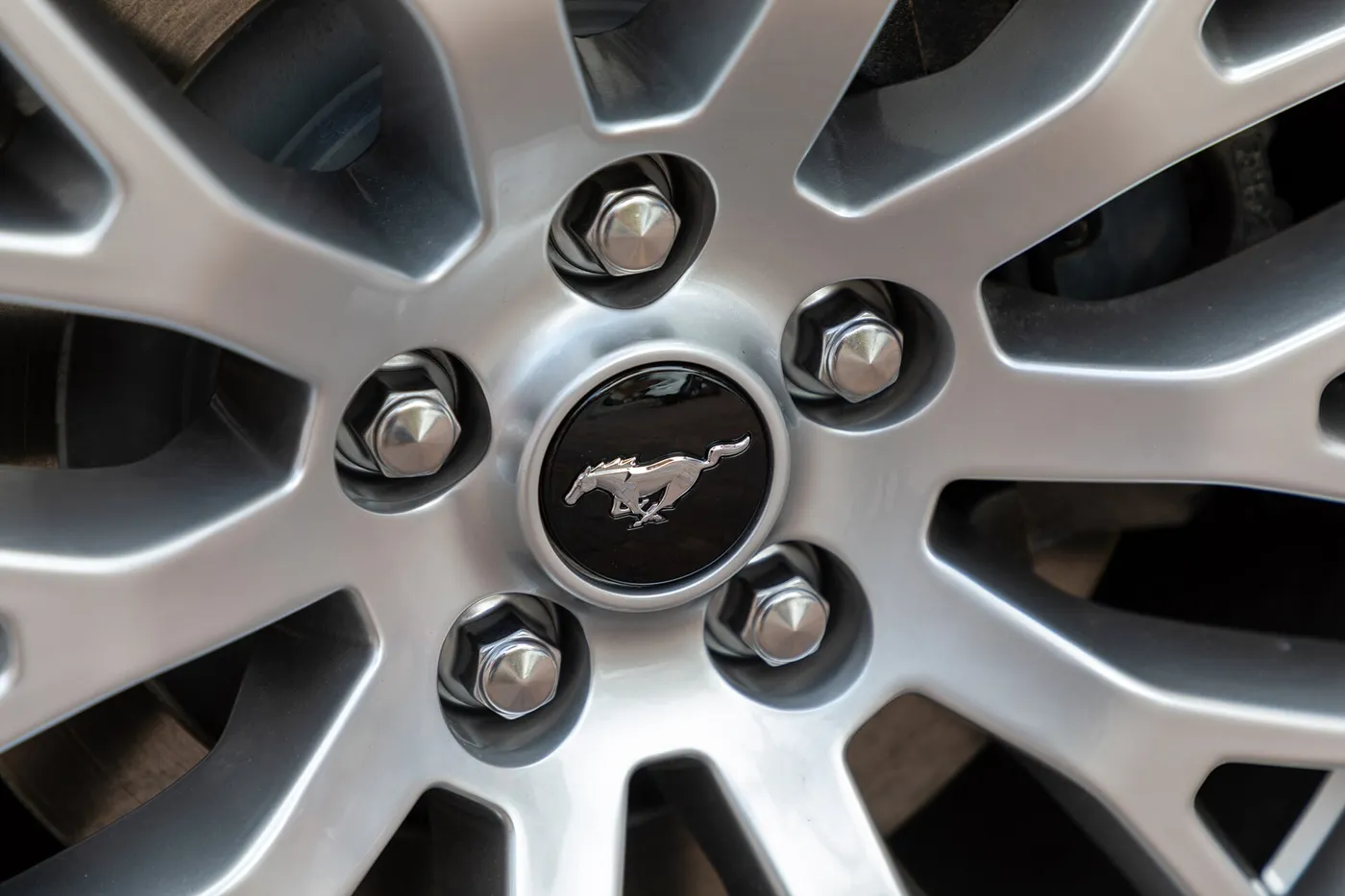
Before you measure anything, count the studs. It sounds too obvious to say, but it is the single most useful step, as you will see in the table below.
| Studs | Method | Accuracy |
|---|---|---|
| 4, 6, 8 | Center of one stud to center of the opposite one | Best for even counts, it reads the circle directly |
| 5 | Center of one stud to the back edge of a far stud | Approximate |
| Any | Two neighboring studs, then the formula or table | Works for every count, best for five |
Four, six or eight studs: straight across
With an even number of studs, one sits directly opposite another, and the line between their centers passes through the middle of the hub. Measure that and you have the bolt circle.
The weak point is finding the center of a stud by eye. The trick that fixes it: measure along the line through both centers, from the outside edge of one stud to the outside edge of the other, then subtract one stud diameter (both studs are the same size). Equivalently, measure from the left edge of one stud to the left edge of the other: same-side edges are already center to center. Edges are easy to see; centers are not.
Five studs: the shortcut, and why we don't love it
Five-lug wheels have no stud directly across. The usual advice is to measure from the center of one stud to the back edge of one of the two studs farthest from it. It gets you close, close enough to tell 5x114.3 from 5x127. It is not exact, though, and when two patterns are a few millimeters apart, close is not good enough.
The method that works on everything
This one works for any stud count, as long as you have counted them. Measure between two neighboring studs, center to center (outside edge to outside edge minus one stud diameter, or same-side edge to same-side edge), and convert:
Two studs side by side are close together, easy to reach with calipers and hard to misread. There is a catch: the formula multiplies any measuring error, by 2 on a six-lug wheel and by about 2.6 on an eight-lug. So on even counts, measuring straight across is still the better reading; the neighbor method earns its keep on five-lug wheels. If you'd rather skip the trigonometry, compare your measurement with this table. The neighbor distances are calculated from the bolt circle and rounded to 0.1 mm and 0.01 in.
| Pattern | In inches | Neighbor to neighbor |
|---|---|---|
| 4 x 100 mm | 4 x 3.94 | 70.7 mm (2.78 in) |
| 5 x 114.3 mm | 5 x 4.5 | 67.2 mm (2.65 in) |
| 5 x 127 mm | 5 x 5 | 74.6 mm (2.94 in) |
| 5 x 139.7 mm | 5 x 5.5 | 82.1 mm (3.23 in) |
| 6 x 135 mm | 6 x 5.31 | 67.5 mm (2.66 in) |
| 6 x 139.7 mm | 6 x 5.5 | 69.9 mm (2.75 in) |
| 8 x 165.1 mm | 8 x 6.5 | 63.2 mm (2.49 in) |
| 8 x 170 mm | 8 x 6.69 | 65.1 mm (2.56 in) |
| 8 x 180 mm | 8 x 7.09 | 68.9 mm (2.71 in) |
Now look at 5x114.3 and 6x135: their neighbor distances are 0.3 mm apart. That is why you count the studs first. Eight-lug heavy-duty patterns sit close together too.
Measure to narrow it down, not to buy
Some patterns are a few millimeters apart across the whole circle. 6x135 and 6x139.7 differ by less than 5 mm. A wheel with the wrong pattern may not go on at all, or may go on without the nuts seating properly, and nuts that are not seated can work loose. So our rule is simple: use the tape to narrow it down, then confirm the pattern for your exact vehicle from an official source before you buy.
For the Ford F-150, Ford's own parts catalog is that source: its Ford Performance wheel M-1007-P2085AA "Fits all 2015-2026 F-150" and lists "Bolt Pattern (PCD): 6 x 135mm" (Ford Performance).
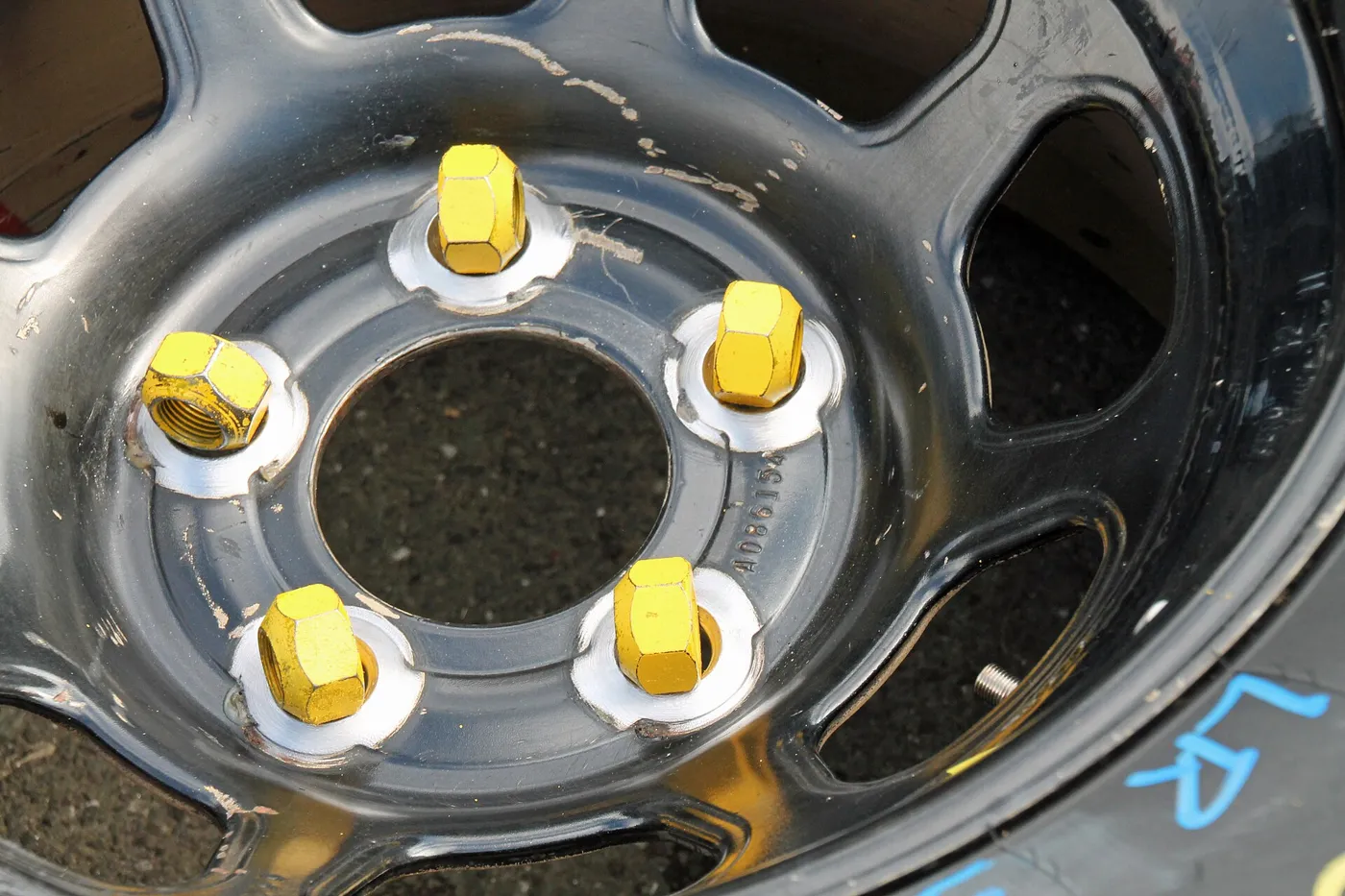
And the bolt pattern is only the first match. The center bore has to fit the hub, the offset has to clear the brakes and suspension, the wheel's load rating has to cover the truck's axle loads, and the lug nuts have to match the stud thread and the seat shape of the new wheel. Once the wheels are on, torque the nuts to the figure in the manual and we would check them again after the first drive. Torque specs and tightening order for each truck are on its spec page: Tacoma, Tundra, 4Runner, F-150, Super Duty.
Sources
- Neighbor distances: calculated from the bolt circle (PCD × sin(180° ÷ studs))
- F-150 bolt pattern: Ford Performance Parts, part M-1007-P2085AA
 5W-20 vs 5W-30